

We’ve all seen these guys with 1,000,000 watts of RV Photo voltaic panels on their roof, and 30 batteries within the stomach of their camper boasting how they’ll run each of their AC models and an air fryer whereas they watch TV of their rig. This text isn’t about a type of techniques, I’m not that man.
My Spouse and I’ve been dwelling on the highway full time in our RV for a couple of yr now.
We tried our hand at Boondocking at a Harvest Hosts one evening, and at 2 a.m. the low battery alarm began going off. Hell we didn’t even make it at some point, we left our campground with full hookups at 9 a.m., acquired there at midday, and 14 hours had no juice left.
Nicely now we have to work out a method to maintain sufficient cost within the batteries in order that I’d be capable of sleep till dawn. We hadn’t executed ANY analysis in any respect on RV Photo voltaic, however then I got here throughout the 400 Watt RV Photo voltaic Equipment from Renogy.

It appeared to have every thing we wanted to throw some panels on the roof, and maintain our batteries charged sufficient to have the ability to use the lights within the kitchen and maintain our low battery alarm from going off, so we ordered it.
We ordered it from Amazon, and it confirmed up at my buddies home in 3 days, and it did include ALMOST every thing we wanted to finish the set up. The one issues it didn’t include was the roof sealant, and a move by means of for the wires to go from the roof down and into the RV, however we ordered these as nicely, so now we had been able to go.

You’ll be able to watch my quick Set up video right here: Renogy RV Photo voltaic Equipment Set up
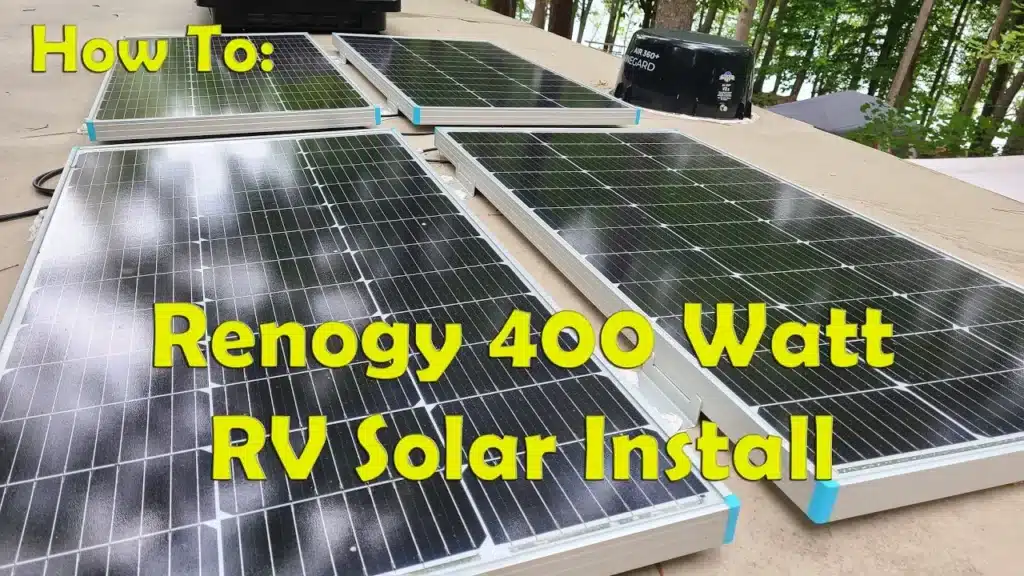
The RV Photo voltaic package from Renogy comes with 4 100 Watt Photo voltaic Panels, a 10 amp inline fuse, panel combiner plugs, cables to go from the roof to the cost controller, a 40 amp MPPT Cost Controller, a Battery fuse, a Bluetooth antennae so you’ll be able to monitor your energy manufacturing with an App in your telephone, and cables to go from the controller to your batteries.
The instructions for set up had been fairly straight ahead, besides how the panels themselves must be wired collectively on the roof. There are just a few choices for placing them collectively, and I’ll admit I did it ‘Improper’ the primary time. With photo voltaic panels you may have the choice of wiring them in Sequence, Parallel, and Sequence-Parallel.
Trying on the elements available, and the included combiner plugs, I assumed they wanted to be wired in Parallel. Which is when all of the Constructive cables tie collectively, and all of the Detrimental cables tie collectively, then go right down to the Cost Controller. Whenever you wire them this fashion, all the Amperage from every Panel is added collectively, and on a full Solar day, will pop the ten amp fuse.
I replaced the fuse, and rewired them in Sequence, Constructive to Detrimental, Constructive to Detrimental, Constructive to Detrimental, Constructive to Detrimental, then right down to the Cost Controller and every thing began working completely.
We had 200 amp hours of normal outdated Deep Cycle Lead Acid batteries from the manufacturing facility, so we figured that must be sufficient storage to maintain us going. We’ve got a residential fridge in our RV that runs off a 1,500 Watt Energy inverter that auto switches ON after we unplug the RV at a campground.
IF we ONLY use the 12 volt lighting, and go away the fridge working like regular, the photo voltaic will cost our batteries throughout the day on a decently Sunny web site, and get us by means of the evening with no battery alarms. Realistically that’s all I used to be searching for, so it was doing what it wanted to do, and will get us off grid often sufficient that I WOULD spend the cash on it once more if we had been to do it over again.
Relating that topic, of If we had it to do over once more, There are issues I might do in a different way, like altering out the batteries, and looking out into the way to dimension the system to get a sure variety of hours out of it. BUT…
Primarily based solely on, whether or not or not this technique carried out as I imagined it could, Sure, it did.
The package got here with most every thing wanted for the set up, It does cost the batteries throughout the day, and the set up was straight ahead. If you’re searching for a straightforward RV Photo voltaic choice, that may get you off grid for the weekend with out a variety of sophisticated math, that is it. Simply be sure to get the roof sealant, and a move by means of, and it couldn’t damage to seize a spare fuse to throw in a junk drawer simply in case.
Keep tuned for my observe up article on evaluating our RV Photo voltaic vs Generator, and the way to dimension an RV Photo voltaic System to get you thru a whole day of clouds and rain.