Obtained a motorhome, campervan or caravan? Wish to know the right way to care to your home leisure battery, the right way to cost it, preserve it and customarily hold it going, particularly in winter? Or nervous about it dropping or not holding cost? Right here’s every little thing it’s worthwhile to learn about your motorhome leisure battery.
Don’t neglect to seize your FREE motorhome upkeep guidelines beneath
*We work onerous to make this the perfect motorhome journey weblog and highway journey web site attainable, stuffed with useful content material for you. The web site is supported by our readers, so should you purchase via hyperlinks on this web site we could earn a commission- at no additional price to you. All opinions stay our personal.
When you discover this publish helpful, you possibly can additionally deal with us to a espresso – we promise to get pleasure from it whereas creating extra helpful content material like this- we’d even bask in a biscuit (or two!)
Motorhome Leisure Batteries
Let’s be honest- most new motorhomers or campervanners don’t actually take into consideration their batteries till they’ve an issue. Both the ability goes, or the battery isn’t holding a cost or they arrive at their motorhome or camper after winter to seek out every little thing is flat and there’s no option to repair it.
If that’s you, don’t worry- you’re not alone. However a fundamental degree of battery upkeep is essential to maintain your leisure batteries wholesome and joyful for his or her lifespan- and make that life span so long as it may be. Your motorhoming will even be a lot simpler should you perceive what your leisure battery is there for and how one can assist it!
It may additionally assist in your yearly motorhome habitation test (or should you do your personal) if in case you have a fundamental understanding of the way it all works.
Motorhome leisure batteries for novices
So, let’s begin at first and go over some fundamentals.
You probably have a motorhome or campervan, you’ve in all probability received each an engine starter battery (the one which begins your automobile and is often discovered within the engine bay) and a leisure or home battery.
NOTE: In case you are shopping for a brand new CARAVAN, they’re typically provided with out a leisure battery, so you will want to purchase one earlier than your first journey.
The motorhome leisure battery is normally NOT within the engine, and is discovered someplace within the camper habitation space. Mine is below the driving force seat, however on my final van it was below the ground close to the oven. Examine your motorhome guide should you’re undecided.
On this publish, we’re going to be focussing simply on the leisure battery, so that you shouldn’t must go anyplace close to the engine bay! We’ll be speaking concerning the fundamentals of leisure batteries, how to decide on one, the right way to care and preserve them (particularly in winter!) and what to do if they’re dropping cost, gained’t cost or appear to be utterly lifeless.
Don’t worry- this publish isn’t for knowledgeable electricians. You don’t want to know amp hours, volts or ‘deep-cycle’ so as to care to your motorhome batteries. And no maths is required (okay, a teeny tiny bit would possibly be- however I promise you are able to do it.)
Why do you want a motorhome leisure battery?
The home leisure battery runs all the ability within the habitation space of your van, everytime you’re not plugged in to mains energy. It’s used for habitation lights, water, rest room, blown-air camper heating, 12v chargers and anything electrical.
IMPORTANT– the leisure battery solely provides 12v in your van. So, in case you are on battery energy, you CANNOT use your 240v (regular 3-pin plug) sockets. So no electrical kettles, or toaster, or microwave (until you’ve got a motorhome generator or an invertor- however that’s a publish for an additional day.)
So as to have the ability to present that energy, the battery ‘shops’ it. Consider it like a bucket of water. You might want to put energy into the battery. When it’s full, no extra energy will be saved. Then, as you employ the ability, it’s drained down. As soon as it’s gone, it’s gone till you replenish the ability.
The large distinction between your campervan leisure battery and the bucket of water is that you just CANNOT utterly empty the leisure battery- doing it will kill it. In actuality, you possibly can solely use about 50% of the ability in your leisure battery earlier than it’s worthwhile to cease draining and begin recharging.
Lithium batteries are totally different in that, you need to use 100% of battery energy and it’ll not harm the battery.
Can’t I simply plug into mains energy on a regular basis? Do I really want a leisure battery in my motorhome?
You would, however the different job of a leisure battery is to clean out irregularities within the energy. With out this, you possibly can find yourself damaging home equipment as a consequence of energy spikes or having home equipment which want fixed energy (like alarms or trackers) going on and off frequently as a consequence of energy fluctuations.
Nevertheless, should you plan to spend most of your time in your motorhome, campervan or caravan on a campsite, you don’t want to purchase a top-of-the-range leisure battery as you gained’t be placing it via as many cycles as somebody who primarily stays off-grid.
Why is your motorhome or camper leisure battery dropping cost?
The opposite factor to know is that the ability in your battery just isn’t like water in a sealed container. Identical to water in a bucket left outdoors on a heat sunny day, the ability in your leisure battery will slowly… disappear (no, it doesn’t evaporate like water!)
It’s like once you get a static shock and your hair stands on finish. Finally, that power simply dissipates. The identical factor occurs to your motorhome batteries (each engine and leisure).
That’s why you typically return to your motorhome, camper or caravan after winter or a interval of inactivity and discover the batteries flat. Even should you’ve turned every little thing off and also you’re satisfied nothing is inflicting the ability to empty ultimately, over time, the battery can be absolutely discharged and/or lifeless.
However don’t worry- with correct upkeep and care, you possibly can defend your batteries, even in chilly climate, and use them for a number of years.
Distinction between an engine battery and a home leisure battery
The two varieties will not be the identical and you can purchase the suitable battery for the job.
Engine starter batteries (or automotive batteries) have thinner plates and are designed for brief, sharp bursts of excessive energy so as to crank your engine and get it going.
Leisure batteries are designed for sluggish launch over a protracted time frame, adopted by re-charging. That is known as ‘deep-cycling’. Leisure batteries are typically known as auxillary batteries too.
“Can I exploit a automotive battery as a substitute of a leisure battery?”
You can not use a leisure battery in your engine (it doesn’t have the ‘oomphf’ to get the engine began), however you possibly can use an engine battery as a leisure should you actually actually needed to. But it surely won’t be anyplace close to as environment friendly and we don’t advocate it.
There’s a kind of battery which may do each jobs (an AGM battery), however it’s not generally used for motorhomes.
What number of leisure batteries do you want in your motorhome or campervan?
Nice question- and the easy reply is, it is dependent upon your van and the way you intend to make use of it.
On my final motorhome, I had an electrical mattress. I beloved the concept of this, as a result of it made life simpler, however, in actuality, that factor was stupidly power-hungry. Because of this, I made a decision to suit a second leisure battery into the motorhome (and it’s one of many many causes I made a decision to simplify and downsize the motorhome.)
IMPORTANT: You MUST solely put a leisure battery within the applicable battery compartment. If there isn’t house for a second battery, you shouldn’t match one. Additionally, you will want to declare becoming a second leisure battery to your insurance- they may require you to get it professionally checked.
On my newest van, and in a number of vans I’ve used, there has solely been one leisure battery- and it’s been completely high-quality. I really like going motorhome wild tenting, and keep off-grid away from campsites as typically as I can, and I nonetheless didn’t really feel the necessity for a second leisure battery (though I do have a photo voltaic panel, which makes an enormous distinction.) however a few years in the past, I’ve upgraded to a lithium battery, which was a gamer changer for off grid!
Motorhome wild tenting guides for the UK & Europe

After all, the extra batteries you’ve got, the LONGER you’ll have battery energy for. Word that I say longer, no more. You possibly can’t match 20 12v leisure batteries and abruptly have 240v energy.
How lengthy ought to a motorhome leisure battery final?
It is a widespread query, with two attainable solutions.
Do you imply how lengthy can you employ electrical objects in your camper earlier than the battery ought to now not be used? That is dependent upon the dimensions of your battery and the way a lot energy you’re utilizing. The extra you’ve got switched on, and the extra ‘power-hungry’ the equipment, the faster the battery will drain.
The quantity on the battery (for instance, ‘110’) refers to ‘Amp-hours’ (Ah) which is the capability of the battery- or how a lot energy it might probably retailer. In easy phrases, it might provide 1A for 110 hours or 10A for 11 hours.
Or do you imply how lengthy do you have to hold a leisure battery earlier than changing it for a brand new one? The lifetime of a leisure battery is dependent upon a number of issues:
- how incessantly it’s discharged
- how deeply it’s discharged
- how rapidly it’s recharged
To ensure that your battery to final so long as attainable, it’s worthwhile to hold it in state of cost. If it discharges to too low a degree and is left for weeks (and even months throughout winter) with out being recharged, then it would in all probability die. And also you want a brand new one.
With correct care, you possibly can count on a motorhome leisure battery to final round 5 years earlier than it ought to be changed. After all, if issues go flawed or aren’t maintained, you possibly can find yourself shopping for a brand new leisure battery yearly!
Kinds of motorhome leisure batteries
There are various kinds of leisure batteries, and also you’ll hear all kinds of thrilling phrases thrown about like ‘lead-acid’, ‘moist batteries’ and lithium ion. Let’s take a look on the choices.
Lead-acid leisure batteries
The commonest type of leisure battery in a motorhome or camper is a lead-acid (though lithium iron is gaining popularity). These are additionally known as ‘moist’ batteries as a result of… they’ve liquid inside them.
Lead acid batteries will self-discharge over time. The velocity of this is dependent upon make, age and so on. You want to have the ability to hold any eye on electrolyte ranges, and high up as essential.
You will get ‘open’ and ‘sealed’ lead-acid batteries. Open are the sort you must high up. Sealed are the ‘maintenance-free’ ones (extra on these beneath.)
Lithium leisure batteries
Lithium batteries are one other type of deep cycle battery. They’re absolutely self-contained (upkeep free) and have their very own cost supervisor. As a result of they don’t have lead, they sometimes weigh round half as a lot as an equivelant lead-acid battery- this will actually assist along with your motorhome payload.
They can be discharged (absolutely) and quickly recharged whereas retaining a steady voltage degree. They’re nice for motorhome homeowners who use their automobiles ‘off-grid’. They don’t self-discharge, are largely maintenance-free and work nicely alongside an inverter.
Nevertheless, they’re expensive- as a lot as 5 instances the price of an equal, good high quality, lead-acid battery
Lithium IRON vs Lithium ion
Bear with me- that is going to get complicated.
There are two widespread kinds of lithium battery- lithium ion and lithium iron phosphate. Lithium iron phosphate (LiFePO4) know-how permits essentially the most cost/ discharge cycles and (not like lithium-ion batteries), prevents attainable fireplace dangers and explosions brought on by overheating.
I’ve Lithium Iron Phosphate battery as my leisure battery and it’s good. I extremely advocate getting it fitted by correctly authorised installers (like Bluefix power or Ecotree), in order that you recognize it’s secure and going to perform in essentially the most effectivity from it.

Different kinds of leisure batteries
- AGM batteries – Absorbent Glass Mat batteries have matting between the plates that filter the sulphuric acid contained in the battery, making it extra resilient and capable of stand up to a larger variety of charging cycles than a typical lead-acid. They can be utilized as each starter and leisure batteries. The draw back is that they’re much dearer to purchase.
- Gel batteries – These are utilized in automobiles with a excessive danger of injury or crashing, comparable to quad bikes or jet skis. They use gel fairly than acid, which reduces the chance if they’re broken in an accident. Some overseas manufacturers of motorhomes or campers at the moment are fitted with these.
- Upkeep-free batteries – Standard batteries have detachable caps to permit the acid ranges to be checked and topped up with deionised water. A brand new possibility is a maintenance-free battery, which is a sealed unit and can’t be topped up, however doesn’t must be, as a result of means it’s charged.
Shopping for & Selecting a motorhome or camper leisure battery
If you end up needing to purchase a leisure battery for a motorhome, campervan or caravan, it may be a little bit overwhelming.
As a tough information, the heavier the battery is, the extra lead it comprises= potential to carry a bigger capability of cost. If you need a deep biking leisure battery (which you in all probability do) a heavy battery is an efficient place to begin.
If you will be spending most of your in a single day stops on motorhome membership campsites with mains hookup, a reasonable battery is perhaps all you want. When linked to a mains provide, the battery is then solely there to ‘clean out’ the 12V output from the camper’s built-in charger.
Nevertheless, should you plan to make use of CS/CL websites with out electrical hook-up or wish to keep off-grid, high quality, high-capacity battery is important. Additionally, should you like to remain in a single place for some time (and due to this fact the alternator isn’t recharging the battery), you’ll want leisure battery for that too. Solely purchase batteries which were manufactured within the final 12 months- outdated batteries might have already got sulphur corrosion.
In addition to selecting the right mannequin, you additionally must ensure you aren’t being bought a starter battery rather than a leisure battery.
The best choice to make sure you get a leisure battery appropriate for a leisure automobile is to purchase one from the Verified Leisure Battery Scheme.
Nationwide Caravan Council Verified Leisure Battery Scheme
This scheme was arrange by the Nationwide Caravan Council to offer homeowners peace of thoughts concerning the high quality of their battery. When you purchase a leisure battery which shows the scheme’s brand, then it has been deemed dependable and match for goal by the NCC.
All verified leisure batteries will show the scheme’s brand in addition to which class it falls into.

How are leisure batteries categorised below the NCC scheme?
There are three classes of verified leisure battery:
- Class A – Excessive storage capability batteries to be used by caravan and motorhome customers preferring to function away from {an electrical} hook-up level (individuals who do a variety of off-grid tenting)
- Class B – Designed for customers who use electrical hook-up on the vast majority of their journeys, but additionally require larger energy capability. Units comparable to motor movers (for caravanners) are more likely to require a Class B battery even when electrical hook-up is used
- Class C – Verified batteries appropriate to be used when electrical hook-up just isn’t accessible for a short while solely
Are all leisure batteries lined by the scheme?
At current, only some producers are included. Extra are anticipated to hitch within the close to future, and the NCC will publish updates as and when applicable. Yow will discover out extra right here.
What impacts a leisure battery’s efficiency?
There are various issues which may have an effect on the efficiency and lifespan of a battery.
- Age – Most batteries have a marked lower in efficiency after 5 years.
- Measurement – Clearly, the larger your battery (in Ah, not bodily dimension), the longer you need to use your home equipment for.
- Consumption– Having stated that, should you’re operating a variety of electrical home equipment directly, you’ll drain the battery sooner and it’ll must be recharged sooner and far more typically. The extra you do that, the extra you degrade efficiency and lifetime of the battery.
- Temperature – Batteries hate chilly. The colder the temperature, the more severe the battery goes to carry out. They actually do sulk. When you test your battery, you’ll see the ‘amp hours’ score can be primarily based on a loopy heat temperature of round 25c, with every diploma decrease inflicting a 1% drop in efficiency. For example, a 110Ah battery which is working in 15c temperature will truly solely carry out as a 100Ah. If that’s not purpose sufficient to go spend your winters in Spain, I don’t know what’s!
The very fact of the matter is, you are able to do calculations all you want, however at all times err on the aspect of warning and assume it’s worthwhile to recharge your leisure battery extra incessantly, and for longer, than you would possibly assume.
Taking care of your Leisure Battery
So, in addition to a bucket of water, consider your battery like a pampered canine. It needs to be heat (however not TOO heat), dry, given consideration, fed typically and given numerous break day to sleep. (I’ve a cocker spaniel curled up on my lap proper now and consider me, the analogy is working!)
Listed below are some tricks to get essentially the most out of your leisure battery.
Do:
- Cost your battery after buy. Keep in mind, they’re discharging whereas simply sitting there on the shelf in Halfords.
- Be sure to set up the battery appropriately, preserving it upright and correctly secured (most motorhomes have straps for this. Use high-quality clamps for connection.
- Maintain the terminals clear and free from corrosion. Some folks add a light-weight coat of vaseline/ petroleum jelly- we don’t do that however we do test them frequently.
- Be sure to know which home equipment are consistently drawing on the battery. Trackers, alarms or safety, rearview cameras, wifi dongles or the clock on the dashboard are all widespread culprits.
- Often test the water ranges within the battery. You do that by unscrewing the caps and ensuring the electrolyte degree covers the lead plates. If not, high up with deionised water as required. All the time put on full security tools when inspecting and sustaining the battery– that stuff is corrosive!
- Be certain the gasoline aid tube stays securely in place.
- Recharge the battery as soon as it reaches 50% energy. By no means permit a battery to utterly run down as this will kill the battery/ tremendously scale back the lifespan
- When you aren’t going to be utilizing the battery for some time, give it a correctly good cost after which retailer it in a cool atmosphere with an applicable charger. You possibly can depart within the van if in case you have an clever charging system or a trickle charger.
Don’t:
- Go away your battery in a discharged state for a protracted time frame When you’ve been utilizing the battery, ensure it’s charged up once more earlier than you allow it in storage/ unused. When you don’t do that, a white deposit will type on the plates and the battery can be unusable (that is known as sulphation)
- Over-charge your leisure battery. A completely charged 12V battery ought to have a voltage of 12.7V. Overcharging will be simply as unhealthy as undercharging for killing off a battery.
- Over-discharge your battery. If the voltage falls to 11.70V cost instantly! If it will get a lot decrease, chances are you’ll not be capable to reserve it.
- Reverse the polarity in your charging leads- this will harm the battery
- Let something fall throughout the battery terminals. A 12V battery is unlikely to trigger electrocution, but when the terminals or the cables are shorted-out, it might probably trigger a fireplace in your motorhome.
- Neglect that the stuff in a lead-acid battery is ACID. I’ve seen it burn via denims when my husband unintentionally spilt some. Watch out and hold nicely away from youngsters and pets.
- retailer your battery anyplace too heat, or purchase a radiator, or in direct daylight
Sustaining your leisure battery throughout Winter
Or, extra typically “My motorhome has been in storage for winter. Why is the battery now flat?”
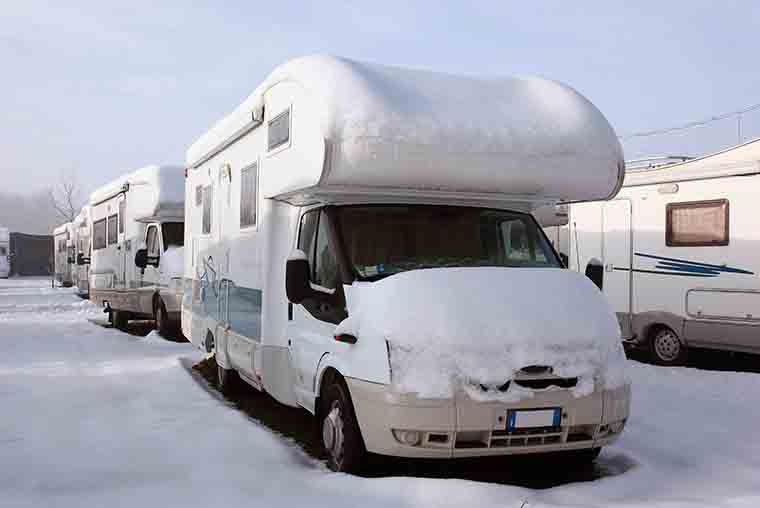
Sadly, most individuals solely uncover they’ve an issue with both their starter battery or their leisure battery once they return to their automobile after a couple of months. Usually that is after winter (though on this age of world lockdowns and pandemics, you’ll in all probability not be utilizing your motorhome as a lot as you deliberate!)
The double-trouble is that you’ve got each lack of use (time whereas the battery quietly discharges) and chilly (which makes the battery depressing.) The 2 collectively imply that the battery discharges extra rapidly, and is much more reluctant to recuperate afterwards.
Listed below are some ideas for caring for and sustaining your leisure battery over winter:
READ MORE: Full listing of every little thing it’s worthwhile to do to put together your motorhome for winter storage
- Give it cost earlier than you place it away for winter
- Go away it with some type of trickle charger, however leaving it plugged into mains for months would possibly harm the battery too. (The usual on-board charger in lots of motorhomes may cause over-charging)
- You probably have an clever battery charging unit (which screens the battery and adjusts charging voltage and present, you possibly can depart that plugged in all winter.
- In case you are unable to connect a charger completely, both cost your leisure battery as soon as a month or take away it from the automobile, convey it dwelling and put it on cost. After all, watch out if this implies your alarm/ tracker turns into disabled- learn extra about motorhome safety right here
- Be certain it doesn’t get too chilly. You probably have inside battery storage within the motorhome, it ought to be okay until it’s REALLY chilly, however if in case you have exterior storage you would possibly wish to take away it to keep away from harm.
- In case you are storing the van at dwelling and have an influence provide, you possibly can put it on a timer (4/5 hours a day) so it doesn’t overcharge
- You should use a photo voltaic panel to offer cost to your battery. Simply remember that photo voltaic panels are much less efficient in winter (weaker daylight) and likewise should you use a motorhome cowl it might cowl the photo voltaic panel, making it ineffective.
How you can cost a leisure battery on a motorhome or camper
Most motorhomes and campers have a number of methods of charging the leisure battery:
- By way of the mains when on hook-up (battery charger)
- Utilizing the engine (alternator) when on the road- that is typically known as ‘split-charge’
- Photo voltaic panel
- Generator
- Wind mills (these are widespread on boats, however much less widespread on motorhomes or campers.)
How you can cost a leisure battery from mains/ electrical hook up
This one is simple. Offering you’ve got a battery charger (extra on these beneath), you simply plug within the mains, flip it on if not already, and calm down. It’s that easy on most fashionable motorhomes and campervans.
How you can cost a leisure battery whereas driving
Keep in mind, it would take time to recharge a battery. Operating your engine for quarter-hour just isn’t going to be sufficient.
Additionally, the alternator was not designed for leisure batteries- it was designed for starter batteries and that’s its important focus. So it’s worthwhile to permit time for the starter battery AND then the leisure battery to be recharged (it’s not linear like that, however all it’s worthwhile to know is it wants time!)
Additionally, because the battery voltage will increase (it will get extra charged), the present supplied by the alternator will reduce- because it must for the engine battery. So an alternator is unlikely to totally cost a leisure battery.
Discharge charges and maths. (DO NOT PANIC…)
For example, if in case you have a 100Ah (amp hour) battery (let’s ignore the temperature and simply assume it’s working to 100), and also you discharge (use) 50%, it’s worthwhile to change 50Ah
Let’s say the engine alternator has sufficient to offer 5A to the leisure battery. It’ll take 10 hours to recharge. That’s 10 HOURS of driving. Continuous.
You probably have an even bigger battery, or two leisure batteries, you will want even longer.
Fortunately, many motorhome on-board battery chargers may give 15-20amps, so it takes quite a bit much less time- 2 or 3 hours. Let’s have a look at these in additional element.
Motorhome Battery chargers defined
Utilizing the mains to cost the leisure battery (and typically the engine battery) is widespread in most motorhomes, however you will want a battery charger. There are a number of kinds of charger available- they do totally different jobs.
Primary chargers
The best is a fundamental unit which supplies a hard and fast output, normally round 13.8 volts. These fundamental chargers are hardly ever utilized in motorhomes today, as a result of multi-stage chargers will not be far more costly and are a lot better for the well being and lifespan of your battery. Primary chargers will not be designed to be left linked long-term.
Multi-stage charger
A multi-stage charger gives cost at totally different voltages and currents relying on the state of cost of the battery. These are additionally known as upkeep chargers, though not many are designed to be left linked permanently- you must use a timer or disconnect and reconnect frequently.
Normally there are 3 phases:
- Bulk cost mode: offers a most voltage and present to recharge the battery rapidly. This normally takes it to round 80% full.
- Absorption: Offers a continuing voltage, however reduces present. Takes it to almost full cost.
- Float cost: Offers lowered voltage and low present to maintain it close to absolutely charged with out harm.
You will get multi-stage fees with much more ranges, however the tough concept is similar.
Do not forget that a battery wants a charger with an output of a minimum of 10% of the battery’s capability. For instance, a 100Ah battery will want a minimum of a ten amp charger. Any much less will scale back the capability.
How massive a battery charger do you want?
The larger the charger (16A as a substitute of 4A), the faster it would cost up your battery. When you keep in mind our earlier instance about needing to switch 50% of a 100A battery, a 16A charger would do it in simply over 3 hours, whereas a 4A one would wish 12.5 hours.
Photo voltaic Energy
Photo voltaic panels are available two important varieties: monocrystalline and polycrystalline. The key distinction between the 2 varieties is dimension – a poly panel will sometimes be about 5% bigger than a mono for a similar quoted output.
Photo voltaic panels will be inflexible or flexible- for vans we advocate inflexible as they’re extra dependable and don’t typically must be walked on.
How massive a photo voltaic panel do I would like?
The reply to this has nothing to do with the dimensions of your motorhome leisure battery. It has to do with how a lot power you intend to make use of. A small campervan with only some LED lights will want MUCH lower than an 8m motorhome with a fridge, heating, a 12v motorhome TV and who needs to cost numerous electrical gadgets. The commonest dimension of photo voltaic panel is 80- 100W.
Additionally, photo voltaic panels are hardly ever nearly as good as they are saying they’re. For example, a 100W panel might technically produce round 8A, however in actuality it will likely be that good – 5 – 6 amps is perhaps extra practical. On cloudy days it’s even much less.

Regulator for solar energy
You probably have a photo voltaic panel, you will want a regulator to regulate the cost going into the battery.
A typical photo voltaic panel in full daylight might produce round 22 volts, which is just too excessive for a 12-volt battery. The job of the regulator is to cut back this to a secure charging degree.
There are various totally different photo voltaic regulators accessible. Cheaper choices embody easy cut up cost or fundamental mounted voltage charging programs; multi-stage charging is best should you can.
Some electrical models (comparable to Sargent) are capable of take the ability from the photo voltaic unit and to up each the leisure and engine batteries as required.These programs typically have a most photo voltaic wattage that they will deal with, so make sure that the panel you select doesn’t exceed it.
Unhealthy scent when charging
Sometimes, you would possibly expertise a ‘rotten egg’ scent when your battery is recharging. This normally signifies that the battery is being overcharged. The scent comes from gasses being emitted. These gasses might doubtlessly ignite and trigger explosions.
When you get this scent, test if the battery feels sizzling to the contact. If is does, the battery is being overcharged and may very well be irreparably broken. Even with out a scent, concentrate on the temperature of your battery whereas charging as a sizzling battery usually means there’s a downside.
All the time have a window open to permit gases to flee whereas the battery is charging.
DO NOT disconnect the battery from the charger whereas it’s plugged into the mains- this might trigger a spark. Disconnect the mains, then take away the charger.
How do you repair a battery which gained’t maintain a cost?
A trickle charger is one of the simplest ways to attempt to repair a leisure battery that won’t maintain a cost. Until it’s been run too low, during which case, see beneath.
How do you revive a leisure battery?
When you’ve unintentionally run your battery too low, sluggish cost it for a minimum of 24 hours and see if it revives. You are able to do this through a battery charger or plugging the motorhome into the mains.
Take the battery out of your camper, join it to an honest battery charger, depart it on trickle cost for a few days (3-4 amps),then test the voltage.
If it’s not rising, the battery might be unfixable and you will want to switch it.
Checking a battery’s cost degree
Many motorhome leisure batteries have a light-weight or show to indicate the cost degree. They will not be 100% correct, however it provides you with a tough concept.
A hand-held unit is mostly extra correct, however pointless in most conditions. When you use a hand-held meter, 12.7+v means absolutely charged, whereas 12v or beneath means discharged. 12.4v is about 50%
You can even use a hydrometer to measure the electrolytes within the cells. The studying ought to be between 1.1 (discharged) and 1.28 (absolutely charged).
Earlier than a studying, flip off all electrical home equipment, together with alarms, fridges and clocks that run off the battery. Failure to take action will lead to an inaccurate studying. Additionally, don’t do a take a look at for 4 hours after driving or utilizing a battery charger- a not too long ago used battery will give a better studying
Secure dealing with of a Lead Acid battery
Battery gasoline is explosive. If it ignites, it might probably trigger burns or extreme accidents. ies and flammable and lead-acid is corrosive. Earlier than you go anyplace close to your lead-acid battery, do the next:
- Put on applicable protecting clothes, gloves and eye-wear. Be warned- the acid can harm clothes
- All the time take away the detrimental terminal first when disconnecting a battery
- By no means smoke or have a unadorned flame close to a battery
- Sparks can typically happen when connecting up a battery and good high quality clamps are wanted. Short-term crocodile clips, typically provided with battery chargers, will not be appropriate for everlasting connections.
Different posts you would possibly discover helpful: