

The Pacific Northwest has gorgeous surroundings, however its interstates are additionally a number of the busiest freight corridors within the nation. When you’re planning a PNW highway journey in 2026, you want greater than a full tank and a strong playlist.
Sharing these highways with heavy industrial vehicles, coping with sudden mountain climate, and navigating fixed building zones all take actual preparation. Consider it as a step up from tackling a Phoenix to Denver highway journey; the stakes on I-5 and I-82 are greater than you may count on.
The 2026 Visitors Actuality on I-5 and I-82
When the Interstate Shuts Down
Multi-vehicle pileups on PNW interstates don’t simply destroy somebody’s day; they ripple by way of complete provide chains. A latest crash shutting down northbound I-5 in South Portland delayed perishable items and idled staff, costing regional logistics networks an estimated $420,000 per hour. That’s not only a trucking drawback. It’s an indication of how fragile these corridors actually are.
For you as a highway tripper, one accident can flip a two-hour stretch into an all-day ordeal. Monitoring real-time site visitors information and having backup routes deliberate isn’t optionally available on these highways.
Excessive-Threat Commute Zones
Building, upkeep, and sudden crashes repeatedly choke site visitors throughout western Washington and Oregon. Main freeway closures on routes like SR 520, I-90, and I-5 pressure important detours, whereas incidents like a morning crash close to Fife can shut down a number of lanes with out warning.
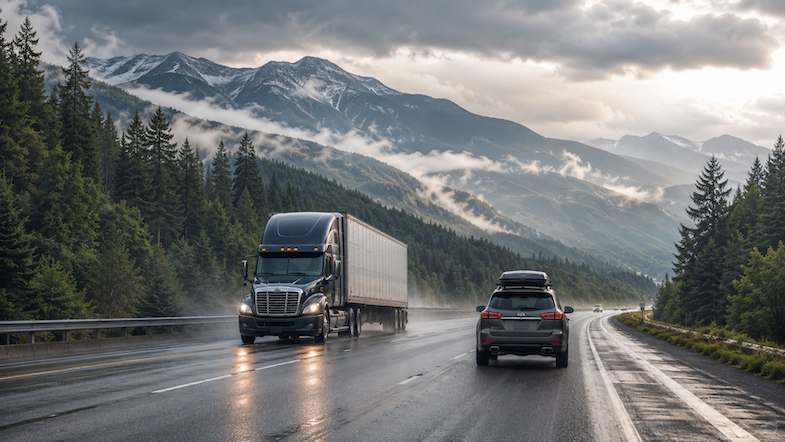
And it’s not simply fender benders. Latest occasions embrace a lethal crash on US 2 north of Spokane and a deadly incident on I-90 close to Liberty Lake. These corridors carry heavy industrial site visitors, which raises the stakes for everybody on the highway.
Sharing the Highway with Heavy Freight
Stopping Distances and Uncooked Physics
Right here’s a quantity that ought to follow you: a completely loaded semi at 65 mph wants roughly 525 ft to cease. That’s 209 ft greater than your automotive. Your car merely can’t soak up the kinetic vitality of a collision with an 80,000-pound tractor-trailer.
The stats inform a grim story. In deadly collisions between a big truck and a passenger automotive, 65% of the fatalities are automotive occupants. So what does that imply for you? Give vehicles area. A number of it.
| Metric | Passenger car | Absolutely loaded industrial truck |
|---|---|---|
| Common weight | 4,000 – 5,000 lbs | As much as 80,000 lbs |
| Stopping distance (65 mph) | ~316 ft | ~525 ft |
| Main blind spots | Rapid rear corners | Entrance (20 ft), rear (30 ft), left (1 lane), proper (2–3 lanes) |
| Fatality danger in collision | 97% of fatalities | 3% of fatalities |
The “No-Zone” and Why It Issues
Ever heard of the “no-zone”? It’s the time period for the massive blind spots round a industrial truck the place the motive force merely can’t see you. In accordance with FMCSA information, one in three collisions between giant vehicles and passenger autos happens inside a truck’s blind spots, often known as “No-Zones.” Moreover, information from the Giant Truck Crash Causation Examine reveals that insufficient surveillance—the place a industrial driver fails to examine or correctly scan their environment—is a vital think about roughly 14% of all large-truck crashes.
A semi’s entrance blind spot extends about 20 ft, the rear stretches as much as 30 ft, and the fitting facet can span two to a few full lanes. That’s an enormous space the place a truck driver has zero visibility.
Authorized professionals who deal with freight accident circumstances constantly stress the significance of staying out of semi truck blind spots. However you don’t want a lawyer to let you know this: if you happen to can’t see the truck’s mirrors, the motive force can’t see you. Cross shortly on the left, and by no means linger alongside a semi.
Mountain Passes and Climate Shifts
Fast Elevation Adjustments
PNW driving can take you from sea degree to a mountain move in beneath an hour. That sort of speedy change brings actual hazards. Northwest mountain passes are identified for steep grades, sudden fog, landslide dangers, and climate that may drop snow or heavy rain on the highway with nearly no warning.
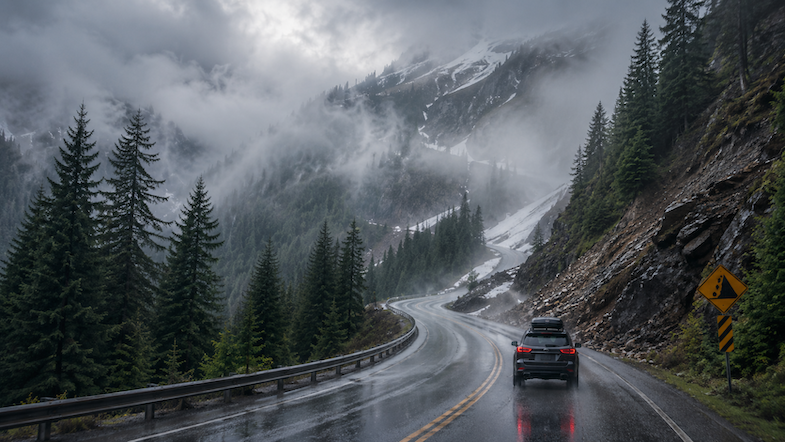
Tire traction can change dramatically inside a couple of miles. Regulate temperature gauges, highway floor circumstances, and climate forecasts earlier than you climb. Sound acquainted if you happen to’ve pushed high-altitude routes earlier than? The PNW simply provides rain and fog to the combination.
Collision Prevention on Harmful Stretches
State companies are actively working to chop the speed of deadly crashes on high-risk highways. After a collection of lethal incidents on US-395, Washington companies teamed up to enhance driver training round merging and correct use of acceleration and deceleration lanes.
Listed below are some particular protocols value constructing into your driving habits on PNW interstates:
- Use acceleration lanes totally. Match interstate pace earlier than merging so that you don’t pressure a truck right into a panic cease behind you.
- Look ahead to sudden closures. Examine real-time WSDOT information earlier than heading onto high-altitude routes just like the North Cascades Freeway.
- Double your following distance within the mountains. Fog and drizzle can seem out of nowhere on move roads. The usual three-second rule isn’t sufficient.
- Cross vehicles decisively. Transfer previous on the left and don’t linger in that right-side blind spot.
The Backside Line for PNW Vacationers
Pacific Northwest interstates are stunning, however they’re working highways first. Heavy freight, unstable mountain climate, and congested corridors all demand your full consideration.
Keep conscious of the vehicles round you, respect stopping distances, and by no means assume a industrial driver can see your car. Plan for climate modifications on mountain passes, preserve backup routes prepared, and examine real-time site visitors information earlier than you hit the highway. Slightly preparation goes a good distance towards conserving your highway journey secure and on schedule.